
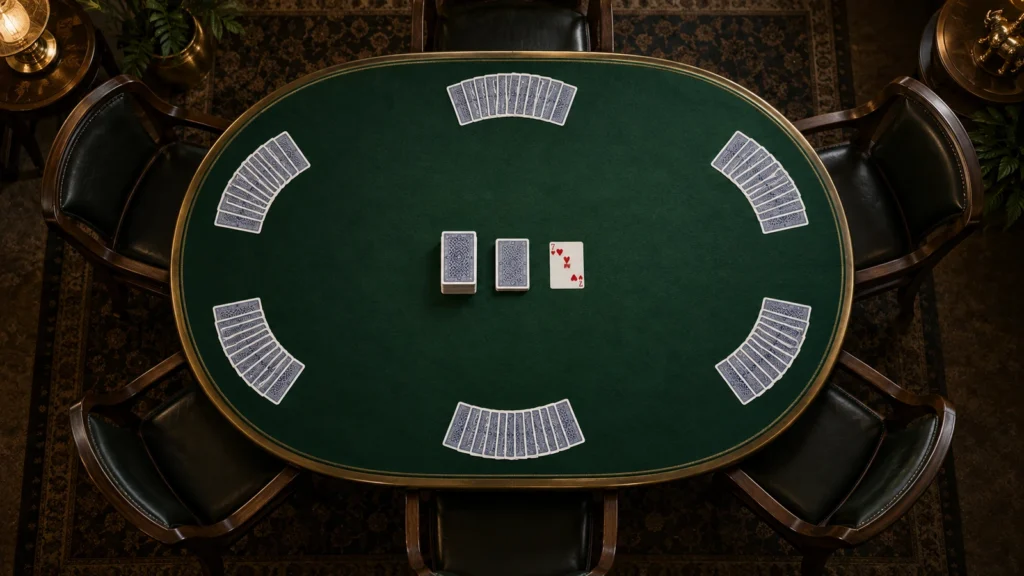
The referenced Indian Rummy rules allow 2 to 10 players. They use two 53-card packs for 2 to 6 players and three packs when 7 or more people play. An online table may offer a smaller range, so its displayed rules are the final check.
The referenced range is 2 to 10 players
Pagat’s Indian Rummy reference says that as many as 10 people can play around one table. That describes the traditional version covered by the source. A particular app or website can set a lower table limit, so do not assume that every online Indian Rummy game offers all ten seats.
Before joining, read the table label rather than relying on a general rule. Confirm how many seats are active, whether empty seats can fill later and whether the game starts with two players or waits for a larger group.
Player count changes the number of decks
In the referenced setup, 2 to 6 players use two standard 52-card decks plus one printed Joker in each deck. That gives 106 cards. When 7 or more people play, the source uses three such packs, giving 159 cards.
More than one deck means duplicate natural cards can exist. Seeing one 8 of clubs in the discard pile does not prove that every copy is unavailable. Check the table’s deck and Joker rules before using visible cards to judge what may still be in the stock.
Every player still starts with 13 cards
The deal gives 13 cards to each player, regardless of whether the table has two seats or several. The remaining cards form the face-down stock after the wild rank and opening discard are set under the referenced rules.
If the draw and discard order is unfamiliar, review the turn-by-turn Indian Rummy guide. It explains why a normal turn briefly takes the hand to 14 cards before one card is discarded.
Table size changes information, not the declaration goal
A larger table produces more visible draws and discards between your turns, but it also spreads cards across more hidden hands. Treat each visible action as evidence, not certainty. Multiple decks and duplicate cards make confident claims about an opponent’s hand especially weak.
Keep your own plan simple. Use the 13-card sorting method, protect a pure sequence and reassess loose cards after each turn. The table size does not remove the need for a second sequence or make an incomplete group valid.
Check the table rules before you commit
Player count is only the first setting. Also check how many decks and printed Jokers are in use, how the wild rank is chosen, which drop or timeout rules apply and how the platform handles a depleted stock. These details vary across tables.
Before declaring, use the valid declaration checklist. Count all 13 cards once, identify at least two sequences and confirm that one is a pure sequence. The active table’s rule screen takes priority over this general guide.
Table check before the first draw
- Confirm the number of active seats and the minimum needed to start.
- Check whether the table uses two decks, three decks or another stated setup.
- Read how printed and wild Jokers work at that table.
- Remember that duplicate natural cards may exist when multiple decks are used.
- Verify that every player receives 13 cards under the selected format.
- Keep the final declaration standard visible: two sequences, including one pure sequence.
Frequently asked questions
Can two players play Indian Rummy?
Yes. The referenced rules include two-player games and use two 53-card packs for tables with 2 to 6 players. The active table may publish its own deck setup.
Can six players play Indian Rummy?
Yes under the referenced version. Six players remain within the two-pack setup, although an online platform may offer fewer seats.
Why are multiple decks used?
Multiple decks provide enough cards to deal 13 to every player and leave a usable stock. They also create duplicate copies of natural cards.
Does the player count change the pure-sequence rule?
No in the referenced rules. A valid declaration still needs at least two sequences, and at least one must be a pure sequence formed without a wild substitute.
Rule source and scope
The player range, deck counts, 13-card deal and declaration structure were checked against Pagat: Indian Rummy: Paplu.