In standard 13-card Indian Rummy, a hand needs at least two sequences and at least one must be pure. That makes the pure sequence the safest first construction goal—not a promise of winning, but the foundation of a valid declaration.
What counts as a pure sequence?
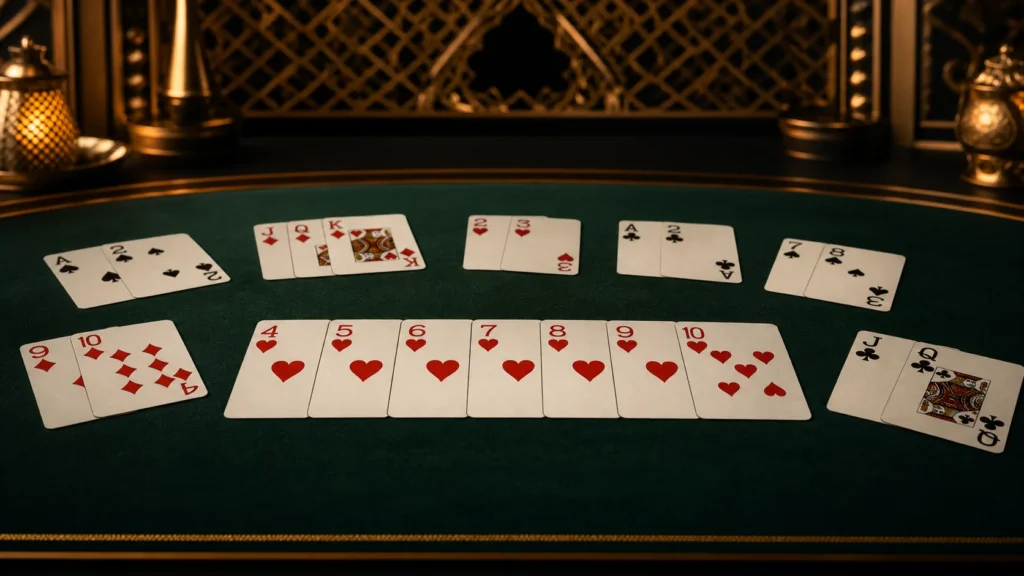
A sequence is three or more consecutive cards of the same suit. A pure sequence uses no Joker as a substitute. For example, 4♥-5♥-6♥ is pure. If a selected wild Joker happens to appear in its natural position—such as 7♥-8♥-9♥ when eights are wild—some rules count it as natural, but the active table rules should always be checked.
Ace can normally sit low in A-2-3 or high in Q-K-A, but not wrap through K-A-2. Cards cannot be reused across two groups.
Why build it before sets and Joker groups?
A set does not replace the second required sequence. A hand full of attractive sets can still fail declaration requirements if it lacks a pure sequence and another sequence. Building purity early reduces the risk of reaching the final turns with groups that look complete but cannot form a valid declaration.
Start by separating natural connectors such as 5♣-6♣ or 9♦-10♦-J♦. Compare open-ended pairs with inside-gap pairs: 5♣-6♣ can accept 4♣ or 7♣, while 5♣-7♣ needs the specific 6♣. This is a decision aid, not a guarantee that the required card will arrive.
Example: lock the life, then reorganise
Suppose your hand contains 4♥-5♥-6♥, 9♣-10♣, 7♦-7♠, Q♠-K♠, a printed Joker and three loose cards. First lock 4♥-5♥-6♥ as the pure sequence. Next preserve at least one realistic second-sequence path—9♣-10♣ can take 8♣, J♣ or a Joker as permitted. Only then compare the pair of sevens and the Q♠-K♠ connector with the loose cards.
Do not break the completed heart sequence just because one of its cards appears useful elsewhere. Reassess loose high-value cards after every draw, but keep the declaration structure visible.
Avoid the most common invalid-declaration errors
Common mistakes include counting an impure sequence as pure, declaring with only one sequence, using the same card in two groups, creating a set with repeated suits where the table forbids it, or assuming K-A-2 is consecutive. Before tapping Declare, count all 13 cards once and verify every sequence and set independently.
Deck count, Joker selection, duplicate-card handling, drop points and score caps differ across platforms. The active game screen and published table rules take precedence over any general guide.
Declaration checklist
- At least two sequences are present.
- At least one sequence is pure and uses no Joker as a substitute.
- Every sequence contains consecutive cards of one suit.
- Every set follows the active table's rank and suit rules.
- No card appears in more than one group.
- All 13 cards are accounted for before declaration.
Frequently asked questions
Can I declare with one pure sequence and only sets?
No under the standard 13-card structure. You need at least two sequences, with at least one pure; the remaining cards may form valid sequences or sets.
Can a Joker be part of a pure sequence?
Not as a substitute. Some rules allow a selected wild card when used at its natural rank and suit, so confirm the active table rules.
Does making a pure sequence first guarantee a win?
No. It protects declaration validity, but draws, opponents and timing remain uncertain.
Glossary
- Pure sequence: Three or more consecutive cards of one suit without a Joker used as a substitute.
- Impure sequence: A same-suit run completed with one or more permitted Jokers.
- Set: Cards of the same rank grouped under the active table's suit and duplicate rules.
Rule source and scope
Rule facts were checked against the independent card-game reference Pagat — Indian Rummy: Paplu.
Apply this decision to the whole hand, not an isolated card. When forming groups and checking a declaration, work through these related checks: Compare sets and sequences; Check every group before declaring; Understand card values and unmatched points.