
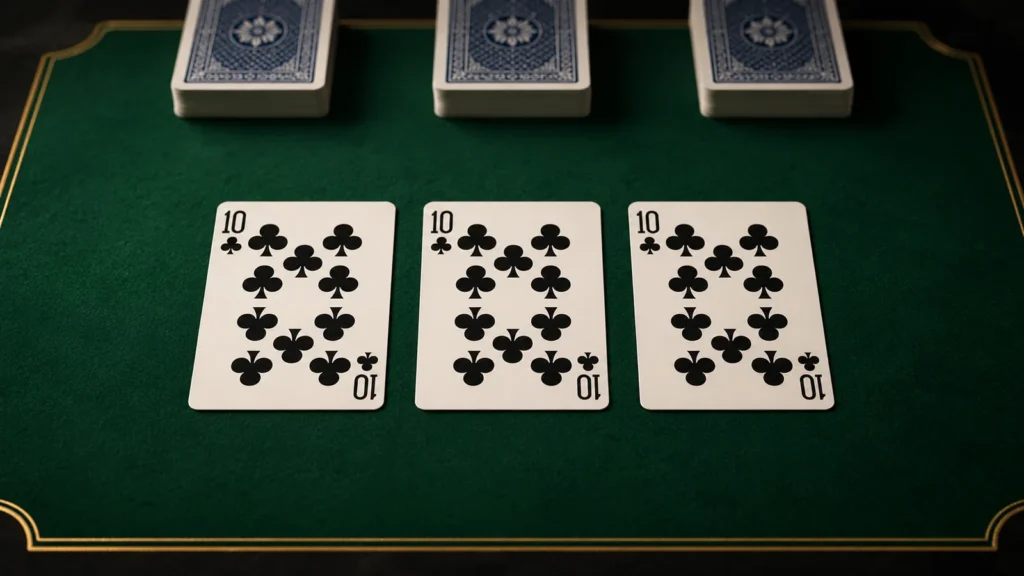
A Tanala is a special three-card combination found in some three-deck Indian Rummy rules. It uses three copies of the same rank and the same suit, such as three 10s of clubs. It is not the same as an ordinary set.
A Tanala uses three identical cards
In the referenced rules, a Tanala contains three cards with the same rank and the same suit. Three 10s of clubs are one example. This combination is possible when the game uses three decks, because each deck can supply another copy of that exact card.
Keep all three physical cards together when sorting the hand. If one card has a different suit or rank, the group is not a Tanala.
Tanala and an ordinary set are different
An ordinary set uses three cards of the same rank in different suits, such as 10 of clubs, 10 of hearts and 10 of diamonds. A Tanala does the opposite on suit: the three cards are identical copies, such as 10 of clubs, 10 of clubs and 10 of clubs.
Review the sets and sequences guide before grouping duplicate cards. It helps prevent a same-suit duplicate from being placed in a normal set by mistake.
The rule belongs to three-deck play
The referenced Indian Rummy rules describe Tanala when three decks are used. That detail matters. A two-deck table cannot naturally supply three identical copies of one standard card, and an online Indian Rummy game may omit the Tanala rule even when its lobby uses several decks.
Open the active rule screen and confirm the deck count, allowed combinations and declaration terms. Do not assume that a rule from one table carries over to another.
A permitted Tanala can count like a straight run
Under the referenced variant, a Tanala is treated as equivalent to a straight run. That can matter when checking the original-life requirement. The same source still requires at least two runs, with at least one straight run or permitted Tanala.
The rest of the 13 cards must also form valid combinations. Use the first-life and second-life guide to check the two-run structure, then verify every remaining card.
Check the whole hand before the final action
A Tanala does not make an incomplete hand valid. Count all 13 cards once, identify the required second sequence, and confirm that no physical card appears in two groups. If the table does not recognize Tanala, rearrange those cards under its listed rules.
Before declaring, run the Indian Rummy declaration checklist. The table’s own validation screen is the final authority for that game.
Tanala check before declaring
- Confirm that the active table uses three decks.
- Check that all three cards have the same rank and the same suit.
- Verify that the table rules explicitly recognize Tanala.
- Do not confuse three identical cards with a normal different-suit set.
- Confirm how the table treats Tanala for the pure-sequence or original-life requirement.
- Identify the separate second sequence and arrange every remaining card.
- Use each physical card once, then check the complete 13-card declaration.
Frequently asked questions
Can three cards of the same suit form a normal set?
Not under the referenced normal-set rule. A normal set uses the same rank in different suits. Three identical same-suit cards are a Tanala only when the active variant permits it.
Is Tanala possible with two decks?
Not naturally with standard decks, because two decks provide only two copies of an exact card. The referenced Tanala rule belongs to three-deck play.
Does a Tanala count as a pure sequence?
The referenced three-deck variant treats it as equivalent to a straight run. Check the active table wording before relying on it for the pure-sequence requirement.
Is Tanala allowed in every online Indian Rummy game?
No universal assumption is safe. Platforms and tables can use different deck counts and combination rules, so read the rule screen before declaring.
Rule source and scope
The three-identical-card definition, three-deck condition, normal-set distinction and straight-run treatment were checked against Pagat: Indian Rummy: Paplu.