
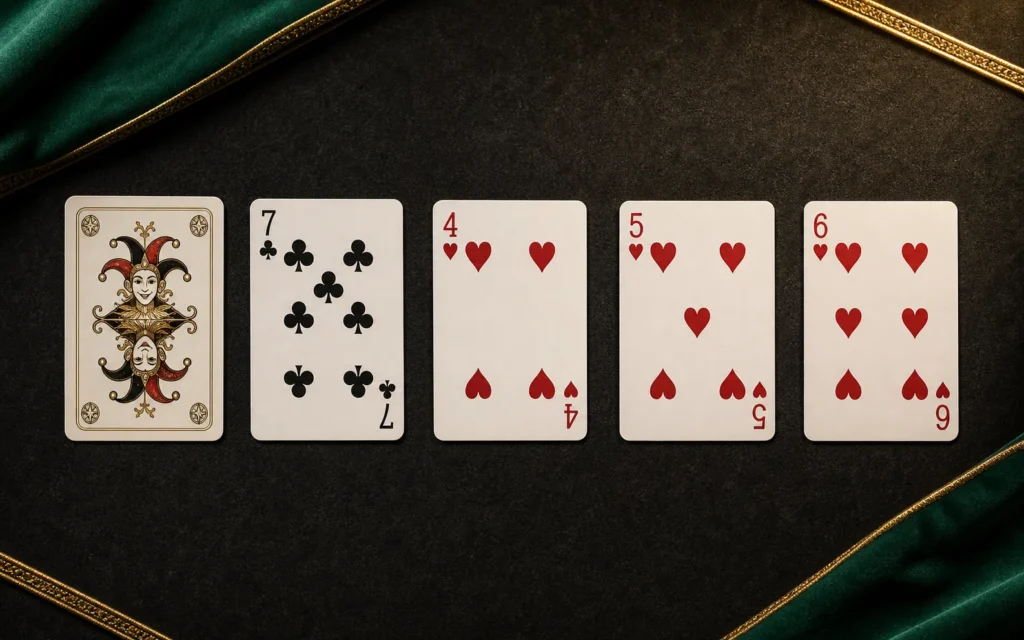
A Joker is a flexible substitute in 13-card Indian Rummy, but it cannot repair every part of a hand. Printed Jokers and the selected wild rank can help complete impure sequences and sets, while at least one required sequence must still be pure under the commonly documented rules.
Printed Joker and wild Joker: what is the difference?
A printed Joker is the dedicated Joker card included in a deck. A wild Joker is created when a rank is selected for the hand: if 7♣ is shown as the selection, the other sevens can normally act as wild cards too. The exact number of available Jokers depends on the number of decks and the platform setup.
Both types can substitute for a missing card where the rules permit. Their flexibility does not change the basic declaration structure: the hand still needs at least two sequences, and at least one of them must be pure.
Where a Joker can—and cannot—be used
A Joker can usually fill a gap in an impure same-suit sequence. For example, 4♥-5♥-Joker can represent 4♥-5♥-6♥. It can also complete a set, such as 9♣-9♦-Joker, with the Joker representing a permitted missing nine.
A Joker used as a substitute does not make a pure sequence. A natural run such as 4♥-5♥-6♥ remains pure because every card appears at its own rank and suit. Some tables treat a selected wild card used naturally—for example, 7♥ inside 6♥-7♥-8♥ when sevens are wild—as natural rather than substituted. Check the active table rules before relying on that variation.
Give every Joker one clear job
Do not place a Joker into the first incomplete group you notice. Compare the whole hand first. A Joker may be more useful in the required second sequence than in a set, because a set cannot replace that second sequence. It may also protect a group containing exposed high-value cards, but point reduction should not hide an invalid structure.
A practical order is: protect the pure sequence, preserve a realistic second-sequence path, then use Jokers in the remaining sequences or sets. Reassess after each draw. A Joker is flexible precisely because it can move between candidate groups until the declaration structure becomes clear.
Example: compare two possible placements
Suppose a hand contains 4♥-5♥-6♥, 9♣-10♣, Q♦-Q♠, a printed Joker, and four loose cards. Lock the heart run as the pure sequence. The Joker can turn 9♣-10♣ into an impure sequence by representing 8♣ or J♣, or it can join the queens as a set.
If the hand has no other credible second-sequence path, using the Joker with 9♣-10♣ protects the mandatory sequence requirement. If another natural sequence is already complete, using it with the queens may be reasonable. The choice depends on the full hand, not on the Joker alone, and it never guarantees the next draw or the final outcome.
Avoid common Joker declaration errors
Frequent errors include calling an impure sequence pure, building only one sequence, leaving a Joker without a clear represented card, counting the same card in two groups, or using duplicate suits in a set where the table forbids them. Another mistake is arranging attractive Joker groups while leaving the required natural sequence unfinished.
Before selecting Declare, name the role of each Joker, verify both required sequences, check every set independently and count all 13 cards exactly once. Deck count, wild-card selection, duplicate-card handling, scoring and declaration controls can vary, so the live game rules take precedence over this general guide.
Joker declaration checklist
- Identify every printed Joker and every card of the selected wild rank.
- Confirm at least two sequences are present.
- Confirm at least one sequence is pure, with no Joker used as a substitute.
- State which exact missing card each Joker represents in an impure sequence or set.
- Check suit, rank and duplicate-card rules for every group.
- Count all 13 cards once before declaring.
Frequently asked questions
Can a printed Joker be used in a pure sequence?
No when it substitutes for a missing card. A pure sequence uses natural consecutive cards of one suit.
What happens when a rank is selected as the wild Joker?
Cards of that rank can normally act as wild substitutes for the hand. The precise selection procedure and special cases vary by table.
Should I always use a Joker in a set?
No. Compare the whole declaration structure first; the Joker may be more important for the required second sequence.
Does receiving more Jokers guarantee a better result?
No. Jokers add flexibility, but a valid pure sequence, uncertain draws and the rest of the hand still matter.
Glossary
- Printed Joker: The dedicated Joker card printed as part of the deck.
- Wild Joker: A card rank selected for the hand whose cards can normally act as substitutes.
- Impure sequence: A same-suit run completed with one or more permitted Jokers as substitutes.
- Natural card: A card used at its own printed rank and suit rather than as a substitute.
Rule source and scope
The Joker selection, sequence and set rules were checked against the independent card-game reference Pagat — Indian Rummy: Paplu.
Apply this decision to the whole hand, not an isolated card. When forming groups and checking a declaration, work through these related checks: Start with the pure sequence guide; Compare sets and sequences; Check every group before declaring.