
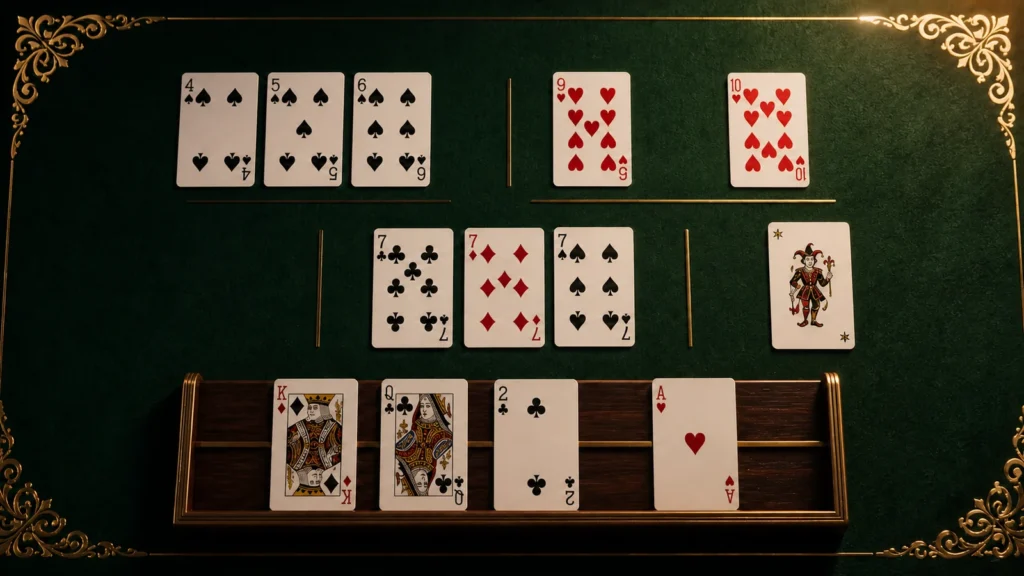
Sorting a 13-card hand is not a declaration and it does not improve the cards you draw. Its job is simpler: make the hand readable. When complete groups, promising routes and loose cards are separated, you can see what each new card changes before choosing a discard. A consistent layout also reduces the chance of counting one card twice or overlooking the required pure sequence.
What must the final hand contain?
Under the referenced 13-card Indian Rummy rules, a valid hand is organised into sequences and sets, with at least two sequences and at least one pure sequence. A pure sequence uses consecutive cards of one suit without a Joker acting as a substitute. A set cannot replace either required sequence.
Sorting should make those requirements visible. Do not place every same-rank pair in a ‘finished’ area or treat a two-card same-suit connector as a sequence. The pure-sequence guide covers the declaration foundation, while the sets and sequences guide explains how to classify completed groups.
The five-zone hand-sorting method
- Locked groups: completed sequences and sets that currently meet the active table rules.
- Pure-sequence route: natural same-suit runs and the strongest same-suit connectors that could become the required pure sequence.
- Second-sequence route: another natural or Joker-assisted sequence candidate, kept separate from the first route.
- Set and Joker options: same-rank pairs, compatible Jokers and alternative grouping ideas that are not yet complete.
- Loose cards: cards with no current valid group or clear nearby role.
These are temporary decision zones, not permanent labels. A card moves when its job changes. If a 7♣ completes 5♣-6♣-7♣, that group can move into the locked zone. If a route loses its useful connector, its remaining cards may need to return to the option or loose zone.
How to sort the opening 13 cards
First scan for complete natural same-suit runs of three or more cards. Set them apart without breaking them to create a more attractive-looking pair elsewhere. Next compare unfinished same-suit routes: open-ended neighbours such as 5♥-6♥ have two nearby extension ranks, while an inside gap such as 5♥-7♥ needs one specific rank. This comparison describes structure, not the chance that a card will arrive.
Then mark same-rank pairs, place Jokers where you can see all possible uses, and collect truly isolated cards in one area. Do not commit a Joker too early if it may be needed for the second sequence. The printed and wild Joker guide explains why the active table’s Joker rules matter.
Worked example: turn clutter into a decision map
Suppose the hand contains 4♠-5♠-6♠, 9♥-10♥, 7♣-7♦, 3♣-5♣, a printed Joker, K♦, Q♣, 2♣ and A♥. Place 4♠-5♠-6♠ in locked groups as the pure sequence. Put 9♥-10♥ in the second-sequence route, and keep 7♣-7♦ in set options because a pair is not yet a complete set.
The printed Joker stays visible beside the option zones rather than hidden inside an unconfirmed group. The 3♣-5♣ inside gap is another route, so compare it with 9♥-10♥ instead of pretending both are complete. K♦, Q♣, 2♣ and A♥ are then judged by any support they have in the actual hand. The exact grouping can change after one draw; the useful part is that the change becomes easy to see.
Re-sort after every draw and discard
When you draw, place the new card beside the zone it may improve before merging anything. Ask whether it completes a valid group, strengthens a required sequence route, creates a competing option or makes an older card redundant. Then compare discard candidates from the loose and weakened-option zones, while protecting required structure.
An open-pile card also reveals information about your interest, while a closed-deck draw is unknown. Sorting does not answer that trade-off by itself; use the open versus closed draw framework when the source of the card matters. After discarding, return to 13 cards and re-check the zones. Never allow an old grouping to remain just because it was convenient one turn earlier.
Use dual-purpose cards carefully
A card can appear useful in two possible groups, but it can belong to only one group in the final declaration. If 7♥ could extend 5♥-6♥ and also join 7♣-7♦, keep both routes visible without counting either as complete until you choose the card’s actual role. This is one reason separate zones are safer than overlapping stacks.
Compare which route protects the pure and second sequences first. Then compare the remaining cards that each choice leaves behind. There is no universal rule that a set route or a sequence route must always win; the whole 13-card structure and active table rules decide.
Common sorting and declaration mistakes
Common errors include locking a two-card pair as a set, mixing suits inside a sequence, using one card in two groups, treating an impure sequence as the required pure sequence, hiding an unused Joker inside a pile, or forgetting to re-sort after a draw changes the hand.
Another mistake is arranging cards only by rank. Rank order is useful inside a suit, but declaration structure depends on suit, sequence role, same-rank alternatives and Joker use. Before selecting Declare, count all 13 cards once, confirm at least two sequences, identify the pure sequence explicitly, and verify that every card belongs to exactly one valid group.
13-card sorting checklist
- Separate every completed valid sequence or set from unfinished candidates.
- Identify one natural route for the required pure sequence.
- Keep the second-sequence route visible and separate.
- Mark same-rank pairs as options, not completed sets.
- Keep Jokers visible until their best legal role is clear.
- Place cards with no current job in a loose-card zone.
- After every draw, move changed cards and return the hand to 13 cards.
- Before declaring, count every card once and confirm the full group structure.
Frequently asked questions
Should I arrange an Indian Rummy hand only by suit?
Suit is useful for finding sequences, but a complete sort should also show same-rank set options, Joker choices, completed groups and truly loose cards.
Can I lock a two-card pair as a completed set?
No. Keep it in an option zone until it meets the active table's requirements for a valid set.
Where should I place a Joker while sorting?
Keep it visible beside possible routes until you know which legal group needs it most. A Joker cannot substitute inside the required pure sequence.
How often should I re-sort the hand?
Review it after every draw and discard because one card can complete a route, weaken another route or change the best loose-card candidate.
Does a five-zone layout guarantee a win?
No. It helps organise decisions and declaration checks, while draws, opponents and outcomes remain uncertain.
Glossary
- Locked group: A sequence or set that currently satisfies the active table rules.
- Route: An unfinished but identifiable path toward a required sequence or another valid group.
- Dual-purpose card: A card that could support more than one possible group but can be used only once in the final hand.
- Loose card: A card with no current valid group or clear nearby grouping role.
- Re-sort: The short review that moves cards between zones after the hand changes.
Rule source and scope
The 13-card grouping objective, sequence requirement and pure-sequence rule were checked against the independent card-game reference Pagat — Indian Rummy: Paplu.