
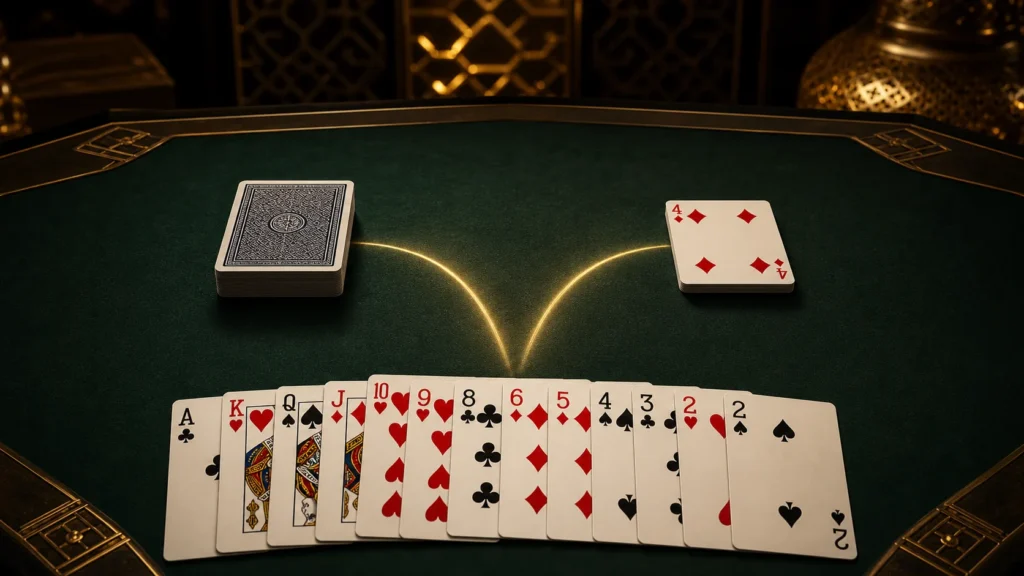
Every turn begins with one choice: take the known top discard or draw an unknown card from the closed stock. The visible card offers certainty but also reveals information; the closed draw hides your intention but may not improve the hand.
Start with the rule, not the hunch
On a standard turn, a player takes either the top face-up discard or the top face-down stock card, then discards one card. In the commonly documented Indian Rummy form, a card taken from the open pile cannot be thrown back in the same turn; a different card must be discarded.
The open card is therefore a commitment. It should have a defined job: complete a pure sequence, complete the second sequence, turn a pair into a valid set, or reduce a clear high-card risk without damaging stronger structure.
Measure improvement against information cost
Picking 7♥ after previously taking 6♥ may tell observant opponents that nearby hearts matter to you. That information does not make the pickup wrong; it is simply part of its cost. If 7♥ completes 5♥-6♥-7♥ as your pure sequence, the structural gain is usually concrete. If it merely creates 7♥-9♥ with a gap, the benefit is weaker.
A closed draw reveals less about the group you are building and can reach several possible outs. But it is unknown, so do not describe it as automatically safer or better. Compare the number of useful cards, the urgency of reducing points and the strength of the visible card.
Example: one card, two different decisions
Imagine the top discard is J♣. If you hold 9♣-10♣ and still need a pure sequence, taking J♣ completes a natural run immediately. The visible signal is worth the structural gain. If you only hold J♦-J♥, taking J♣ may form a set, but first confirm that the hand already has a path to the mandatory two sequences.
If J♣ fits neither a strong run nor a required set, drawing closed keeps more possibilities open. After the draw, choose a discard by protecting completed groups, reviewing isolated high cards and avoiding assumptions based on one opponent action.
Observe patterns without pretending to see hidden cards
Visible pickups and discards are evidence, not proof. One pickup can support a sequence, a set, a temporary hold or point reduction. Use repeated actions to form a cautious working hypothesis, and abandon it when later cards contradict it.
Never break a completed pure sequence solely to avoid a speculative feed. Your own valid structure and point exposure are known; an opponent’s concealed hand is not. Table timers, stock recycling, auto-discard behaviour and scoring details may vary, so consult the active platform rules.
Five-question draw checklist
- Does the open card complete a valid group now rather than merely look connected?
- Does the hand still satisfy the pure-sequence and second-sequence requirements?
- What useful information will the visible pickup reveal to opponents?
- How many different closed-deck cards could improve the same group?
- Which different card will be discarded after the pickup, and what point or feed risk does it carry?
Frequently asked questions
Is the closed deck always the safer draw?
No. It conceals your target but gives an unknown card. A visible discard that completes required structure can be the stronger choice.
Can I pick the open card and discard it immediately?
In the commonly documented Indian Rummy form, no; after taking the top discard you must discard a different card. Check the active table rules.
Can watching discards tell me an opponent's exact hand?
No. It supports cautious hypotheses only; hidden cards and alternative uses remain unknown.
Glossary
- Open pile: The face-up discard pile whose top card can be seen before a draw.
- Closed deck: The face-down stock from which the next card is unknown.
- Information cost: What a visible pickup may reveal about the suit, rank or group a player values.
Rule source and scope
Turn structure and combination rules were checked against the independent card-game reference Pagat — Indian Rummy: Paplu.
Apply this decision to the whole hand, not an isolated card. When forming groups and checking a declaration, work through these related checks: Start with the pure sequence guide; Compare sets and sequences; Check every group before declaring.