
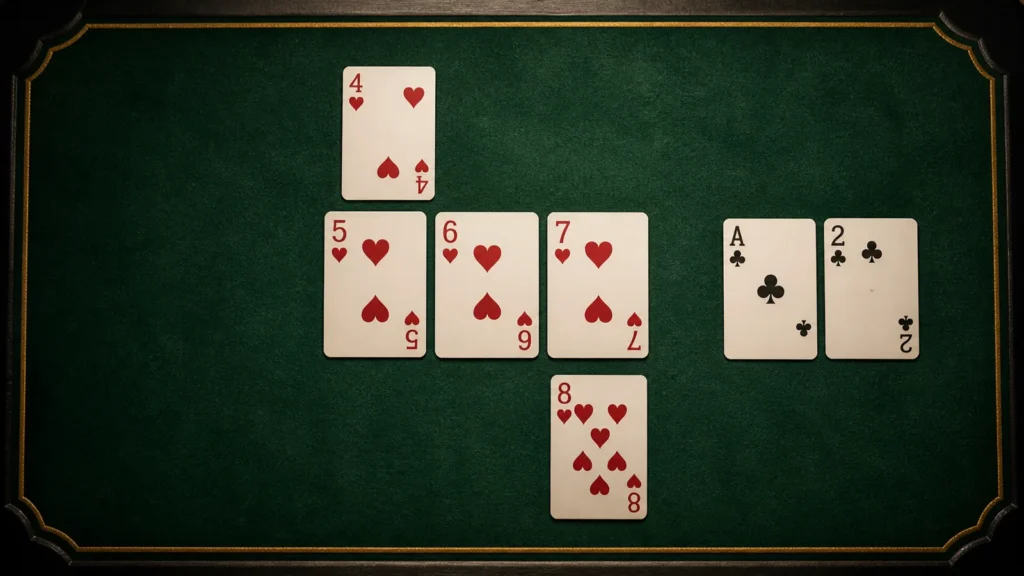
Middle cards are useful in 13-card Indian Rummy because they can connect to ranks on both sides. That does not make every middle card worth keeping. Suit, existing neighbours, the two-sequence requirement and the rest of the hand matter more than rank alone. This guide turns card flexibility into a small comparison you can repeat after every draw.
Start with the sequence rule
Under the referenced Indian Rummy rules, a sequence contains at least three consecutive cards of the same suit. Ace may sit low in A-2-3 or high in Q-K-A, but K-A-2 is not a valid sequence. A valid declaration needs at least two sequences, with at least one natural or pure sequence that does not use a Joker as a substitute.
Flexibility is therefore about legal same-suit routes, not cards that merely look close in rank. The pure-sequence guide explains the declaration foundation. Use the present framework only after checking suit, order and the active table’s rules.
Why middle ranks can offer two directions
A middle-rank neighbour pair can often extend at either end. With 5♥-6♥, either 4♥ or 7♥ creates a natural three-card sequence. The pair has two distinct legal extension ranks. A♣-2♣ at the low edge has only 3♣ as a nearby three-card completion, because K♣-A♣-2♣ is not legal.
This comparison does not mean a five or six is automatically better than an ace. Q♠-K♠ can extend with A♠ at the high edge, and an ace may already belong to a complete group. Rank flexibility is one input. A finished valid group, a required sequence and the actual support in the hand take priority over a loose middle card.
Open-ended neighbours versus an inside gap
Neighbouring cards such as 5♦-6♦ form an open-ended two-card route because 4♦ or 7♦ can complete a three-card run. A gapped route such as 5♦-7♦ needs 6♦ for the simplest completion. Both are unfinished and neither may be declared as a sequence yet, but their structures are different.
Do not turn that difference into a claimed draw probability. Multi-deck games, visible discards, cards already in your hand and platform-specific rules affect which physical copies remain available. Use ‘two legal extension ranks’ and ‘one inside-gap rank’ as labels for the route, then reassess when real information changes.
Compare routes inside the full 13-card hand
First protect completed groups and the strongest route to the required pure sequence. Next identify a realistic second-sequence route. Only then compare optional connectors. If 5♥-6♥ supports your missing pure sequence, it carries more structural value than a flexible pair competing for a third or fourth group. If both required sequences are already safe, the same pair becomes an option rather than a necessity.
Use the five-zone hand-sorting method to keep locked groups, sequence routes, set candidates and loose cards separate. A flexible-looking card that forces you to break a completed pure sequence is usually solving the wrong problem.
Worked comparison: 5-6 hearts and ace-two clubs
Suppose an unfinished hand contains 5♥-6♥ and A♣-2♣, while neither route is complete. The heart pair has two nearby extension ranks: 4♥ and 7♥. The club pair has one low-edge extension: 3♣. On structure alone, the heart pair offers more directions.
Now add the rest of the hand. If 3♣ is already visible on top of the open pile and taking it completes the only realistic pure sequence, A♣-2♣ may become the immediate priority. If 5♥-6♥ overlaps with a same-rank set plan, one card can be used only once in the final declaration. The open versus closed draw framework helps compare immediate improvement with the information revealed by an open-pile pick.
Recalculate after every draw and discard
After drawing, place the new card beside every legal route it could support before committing it. Ask whether it completes a sequence, changes an inside gap to an open end, creates a competing set route or makes an older card redundant. After discarding, return to 13 cards and update the map.
A 7♥ drawn beside 5♥-6♥ completes 5♥-6♥-7♥; it may also be useful with two sevens of other suits. Do not count it in both places. Compare which use protects the required sequences and what each choice leaves unmatched. The sets versus sequences guide covers this one-card, one-group rule in more detail.
Common flexibility mistakes
Common errors include mixing suits, treating two cards as a completed sequence, assuming every middle rank has equal value, counting unavailable cards as certain future draws, keeping too many competing connectors, or using the same card in two possible groups. Another mistake is breaking a complete pure sequence just to create two unfinished routes.
Before declaring, stop using route labels and verify the actual hand: all 13 cards counted once, at least two valid sequences, at least one pure sequence, and every remaining card in a valid sequence or set. No flexibility framework can guarantee a draw, declaration or result in an online Indian Rummy game.
Middle-card flexibility checklist
- Confirm that every route uses one suit and consecutive legal ranks.
- Protect completed groups and the required pure-sequence route first.
- Label neighbouring middle cards by both legal extension ranks.
- Label inside gaps by the specific missing rank without assuming it will arrive.
- Treat ace as low or high in a legal run, never both in K-A-2.
- Compare optional connectors only after identifying the second-sequence route.
- Use each physical card in only one final group.
- Recalculate after every draw, discard and visible-card change.
Frequently asked questions
Which cards are middle cards in Indian Rummy?
There is no special rule category called middle cards. The term is a planning label for ranks away from the ace and king edges that may connect to same-suit cards on both sides.
Is 5-6 always better than ace-two?
No. 5-6 has two nearby legal extension ranks while ace-two has one low-edge extension, but completed groups, suit support and the full declaration structure can make ace-two more useful in a real hand.
Is 5-7 an open-ended route?
No. It is an inside-gap route that needs the same-suit six for the simplest three-card sequence. A neighbouring pair such as 5-6 is open-ended.
Can ace connect king and two together?
No. Ace can be low in A-2-3 or high in Q-K-A, but K-A-2 is not a legal run under the referenced rules.
Does keeping flexible cards guarantee a declaration?
No. The framework only compares current legal routes. Draws and outcomes remain uncertain, and active table rules always take precedence.
Glossary
- Open-ended route: Two neighbouring same-suit cards that can form a three-card sequence with a legal rank at either end.
- Inside gap: Two same-suit cards separated by one missing rank inside the route.
- Edge card: Ace, two, queen or king when a route approaches the low or high end of legal sequence order.
- Extension rank: A rank that legally lengthens or completes the same-suit route being assessed.
- Route map: A temporary view of unfinished sequence options that must be updated as the hand changes.
Rule source and scope
The sequence order, ace boundary, 13-card grouping objective and declaration requirements were checked against the independent card-game reference Pagat — Indian Rummy: Paplu.