
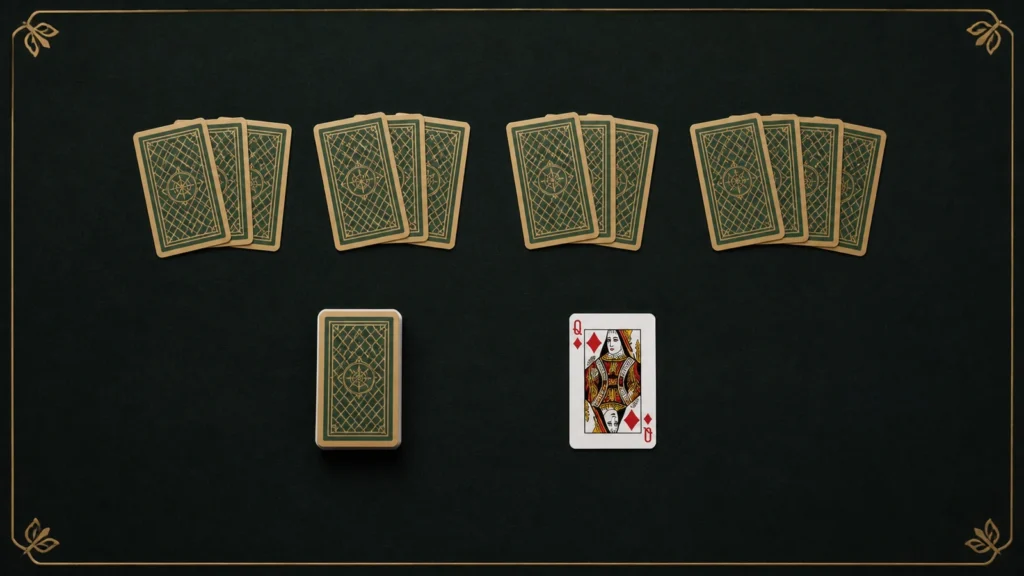
A turn in 13-card Indian Rummy follows a simple order: draw one card, review the 14-card hand, discard one card, and check whether the remaining 13 cards satisfy the active table's declaration rules. The order is easy to remember, but every step has a different job. This guide explains the flow without pretending that one draw, discard or grouping method guarantees a result.
Know the 13-card objective before the first turn
The referenced Indian Rummy rules deal 13 cards to each player. The objective is not merely to collect matching cards. A valid declaration needs at least two sequences, with at least one pure sequence that uses no Joker as a substitute, while every remaining card must fit a valid sequence or set.
Start by separating completed groups from unfinished routes. The five-zone hand-sorting method gives a reusable layout for locked groups, pure-sequence routes, second-sequence routes, set or Joker options, and loose cards. This makes the effect of each draw easier to see.
Step 1: choose the stock or the open discard
At the start of a normal turn, choose either the top card of the face-down stock or the top available card of the face-up discard pile. The open card gives known information: you can see whether it completes a group before taking it. The stock card is unknown, so it reveals less about your plan but may not help the current hand.
Do not choose by habit. Ask what exact job the open card would perform. Does it complete the needed pure sequence, create the second sequence, complete a valid set, or replace a weaker loose card? The open versus closed draw framework covers this comparison in more detail. Under the referenced rules, a card taken from the open pile cannot be discarded again in that same turn; check the active table for its exact implementation.
Step 2: regroup the temporary 14-card hand
After the draw, the hand temporarily contains 14 cards. Place the new card beside every legal route it can serve before deciding where it belongs. A drawn 7♥ might extend 5♥-6♥ into a pure sequence, while the same rank could also join two sevens of other suits as a set candidate. It can occupy only one final group.
Review in a fixed order: completed pure sequence, second-sequence route, other valid groups, then loose cards. This prevents an attractive set from hiding a missing sequence. Use the sets versus sequences guide when one card appears useful in two places, and count each physical card once.
Step 3: discard one card and return to 13
A normal turn ends by placing one card face up on the discard pile, returning the hand to 13 cards. Protect complete groups first. Then compare loose cards by their current same-suit or same-rank support, the role they play in the two required sequences, and what the draw has made redundant.
A high-point card is not automatically the correct discard, and a low-point card is not automatically safe. Breaking a complete pure sequence to remove points can damage the declaration structure. The high-card decision guide provides a bounded checklist without claiming that any ordinary discard is perfectly safe.
Step 4: run the declaration check
After choosing the discard, verify the remaining 13 cards rather than relying on how the groups look. Count every card exactly once. Confirm at least two valid same-suit sequences, identify the pure sequence explicitly, and make sure every other card belongs to a valid sequence or same-rank set under the active rules.
The pure-sequence guide explains why a set cannot replace the required sequence structure. If any card remains loose, a group mixes suits incorrectly, a set repeats a suit where the table forbids it, or one card has been counted twice, the hand is not ready to declare.
Worked turn: draw, compare, discard, verify
Suppose the 13-card hand contains 4♥-5♥, 8♣-9♣-10♣, three queens of different suits, 2♠-3♠, a printed Joker, K♦ and 7♣. The heart pair is an unfinished pure-sequence route; the club run is a completed pure sequence; the queens are a valid set; and the remaining cards still need clear roles.
If 6♥ is available from the open pile, taking it creates 4♥-5♥-6♥. The temporary 14-card hand now has two natural sequences plus the queen set. Reassess 2♠-3♠ with the Joker and compare K♦ with 7♣ as the loose-card decision. After one discard, count the 13-card result again. Do not declare unless the remaining cards all form valid groups; the useful draw alone does not prove the whole hand is valid.
Common turn-order and declaration mistakes
Common mistakes include drawing without naming the card’s job, forgetting that the hand temporarily contains 14 cards, discarding from a complete required sequence, re-discarding the open card when the table forbids it, counting one card in two groups, or pressing Declare because most rather than all cards appear arranged.
Another error is assuming every online Indian Rummy game uses identical controls, Joker rules, deck counts, scoring or declaration timing. Use this article for the core draw-regroup-discard-check framework, then read the active table rules before play. No turn order or checklist can guarantee a draw, declaration, score or win.
Turn-by-turn checklist
- Start the turn with exactly 13 cards and identify the pure-sequence route.
- Choose the face-down stock or face-up discard by naming the new card's job.
- After drawing, count 14 cards before changing any group.
- Protect completed sequences and use each physical card in one group only.
- Compare loose cards only after the two required sequence routes are clear.
- Discard exactly one card and return the hand to 13.
- Before declaring, confirm two sequences, one pure sequence and no loose card.
- Check the active table's Joker, open-pile, scoring and Declare-button rules.
Frequently asked questions
How many cards do I hold during an Indian Rummy turn?
You normally begin with 13, draw one to make 14 temporarily, then discard one to return to 13. Active table variations should still be checked.
Can I take the open discard and throw it back immediately?
Not under the referenced rules. If you take the top open discard, you must discard a different card in that turn. Verify the exact rule shown by the active game.
Should I make sets before sequences?
Protect the required sequence structure first. A valid declaration needs at least two sequences and at least one pure sequence under the referenced rules; a set cannot replace them.
When should I press Declare in an online Indian Rummy game?
Only after the remaining 13 cards have been checked once each and all belong to valid groups. Interface steps and timing vary by provider, so follow the active table instructions.
Does a strong draw guarantee a valid declaration?
No. A draw may complete one group while other cards remain invalid. Recheck the entire 13-card hand after the discard.
Glossary
- Stock: The face-down pile from which the top unknown card may be drawn.
- Open discard: The visible top card of the face-up discard pile that may be available to take.
- Temporary 14-card hand: The hand immediately after drawing and before discarding one card.
- Pure sequence: A same-suit run of consecutive cards without a Joker substituting for another card.
- Declaration check: The final count that verifies every one of the 13 cards and the required sequence structure.
Rule source and scope
The 13-card deal, draw-and-discard turn order, open-pile restriction, sequence and set definitions, and declaration requirements were checked against the independent card-game reference Pagat — Indian Rummy: Paplu.