Knowing card values helps you read an unfinished hand, but it does not replace the pure-sequence requirement or the active table's scoring rules.
Points and valid groups are different checks
Points describe cards still unmatched when a hand ends. A valid declaration is a separate structure test: the referenced 13-card rules require at least two sequences and at least one pure sequence. A low-looking hand can still be invalid without that pure sequence.
Secure the pure sequence first, then use card values to decide which unfinished route deserves attention.
A simple card-value map
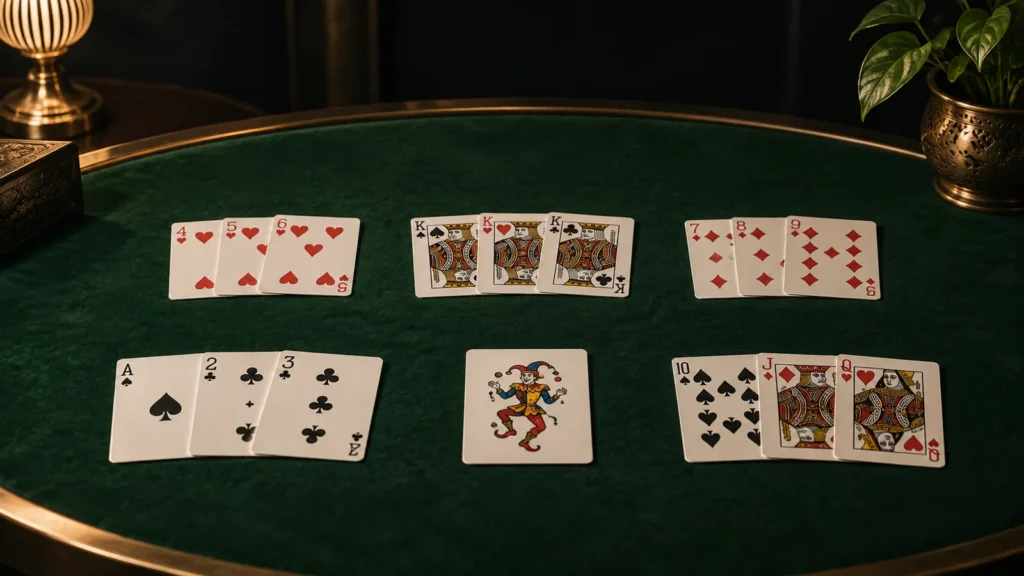
A 2 through 10 is commonly counted at its face value. In the referenced Indian Rummy rules, aces and court cards such as Jack, Queen and King are commonly counted as 10 points when unmatched. Printed and wild Jokers are generally treated as zero for this basic calculation.
An unmatched 8, Queen and Ace would therefore be read as 8 + 10 + 10 under that common map. A table may apply a cap, special drop treatment or another scoring variant, so this is a learning example rather than a settlement quote.
Read an unfinished hand calmly
When another player may be close to declaring, first identify whether high cards are protected in a valid sequence or set. A King inside a completed pure sequence is not a loose 10-point concern. Mark completed groups, likely groups and genuinely loose cards instead of reacting to every high card.
The 13-card sorting guide helps keep those zones visible before a discard decision.
Use Jokers to finish structure, not to skip rules
A Joker can make a permitted group usable, but it does not make every arrangement valid. Do not use a Joker as a shortcut around the required pure sequence. Give each Joker an explicit role, then check that moving it would not break another group.
Review the printed and wild Joker guide when the role is unclear.
End-of-hand routine
Count only cards that are not in accepted groups, re-check the pure sequence, and use the table’s own scoring screen as the authority. If declaring, run the valid-declaration checklist before the final action. Card values support disciplined choices; they cannot predict a draw, score, result or win.
Card-value check before a hand ends
- Identify the pure sequence before thinking about point totals.
- Mark completed sequences and sets so protected cards are not counted as loose.
- Count unmatched numbered cards at their displayed value under active rules.
- Check how the table treats aces, court cards, Jokers, caps and drop penalties.
- Give each Joker one clear permitted role.
- Use the active table rules as the final authority on scoring and settlement.
Frequently asked questions
How much are face cards worth in Indian Rummy?
In the referenced rules, Jack, Queen, King and Ace are commonly counted as 10 points when unmatched. Check the active table because formats and caps can vary.
Are Jokers worth points?
The referenced basic treatment counts printed and wild Jokers as zero, but their permitted use should be checked in the active rules.
Can low points make an invalid declaration valid?
No. A declaration still needs the required sequences, including a pure sequence, plus valid remaining groups.
Do lower points guarantee a better result?
No. Point awareness is educational hand management, not a guarantee about draws, opponents, scoring or outcomes.
Rule source and scope
Card values and the fact that table scoring and penalties can vary were checked against an independent Indian Rummy rule reference. Pagat — Indian Rummy: Paplu.