
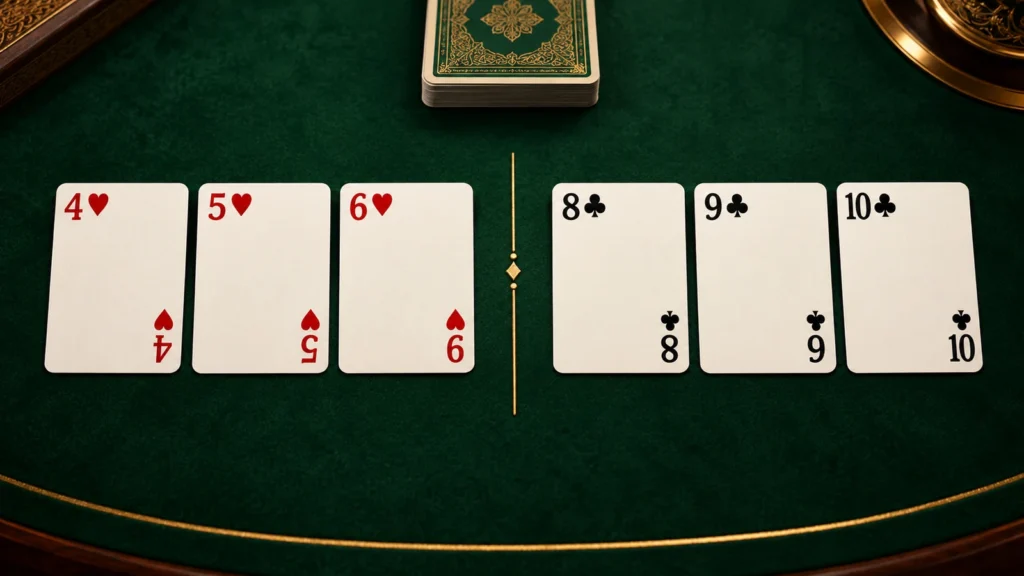
In the referenced 13-card Indian Rummy rules, the first life is the first pure or straight sequence. The second life is another valid sequence; it may be pure or use a permitted Joker as a substitute. The names vary by table, but the structural check remains two sequences with at least one pure sequence.
First life means the required pure sequence
The source calls the first straight run the original life. In current online Indian Rummy language, this is commonly described as the first life: three or more consecutive cards of the same suit with no wild card replacing a missing natural card.
For example, 4♥-5♥-6♥ is a pure sequence. Protecting it early gives the hand the required pure foundation, but it does not by itself make the full 13-card declaration valid. Review the pure-sequence guide if the difference between natural and substituted cards is unclear.
Second life means a separate second sequence
The second life is another valid run of at least three consecutive cards in one suit. It can be another pure sequence, such as 8♣-9♣-10♣, or an impure sequence when the active rules allow a Joker to stand in for a missing card.
The key word is separate. Each physical card can belong to only one group. A four- or five-card sequence is still one sequence, not two lives. The sequence card-count guide explains why length and sequence count are different checks.
A set cannot serve as the second life
A set groups cards of the same rank in different suits. It can help complete the rest of a valid hand, but it does not replace the second required sequence. A hand with one pure sequence and several sets is still missing its second life under the referenced rules.
Label each group before declaring: pure sequence, second sequence, then any additional sequence or set. If a group cannot be named without reusing a card, the declaration needs more work. Compare the structures in the sets-versus-sequences guide.
Check both lives inside the full 13-card hand
Finding two sequences is only part of the declaration. Every one of the 13 cards must appear exactly once in a valid group. Loose cards, duplicate use of one card, an invalid wrap such as K-A-2 or a Joker placed against the table rules can still invalidate the hand.
Use a left-to-right audit: count 13 cards, point to the pure sequence, point to the separate second sequence, then validate each remaining set or run. Finish with the Indian Rummy declaration checklist rather than relying on how tidy the groups look.
Read the active online table rules
Platforms may label these requirements as first life and second life, first sequence and second sequence, or simply the minimum sequence rule. Joker handling, deck count, scoring and declaration controls can also differ.
Before joining an online Indian Rummy game, open its rule screen and confirm how it defines a pure sequence, whether a wild-rank card used naturally stays pure and how invalid declarations are handled. The active table rules take priority over this general educational guide.
First-life and second-life declaration checklist
- Count all 13 physical cards once before judging the groups.
- Identify one pure sequence of at least three consecutive same-suit cards.
- Identify a separate second sequence; pure or permitted impure according to the table rules.
- Do not count one long sequence as two lives.
- Do not use a set as a substitute for the second sequence.
- Confirm every remaining card belongs to one valid sequence or set.
- Recheck the active table's Joker and declaration rules before the final action.
Frequently asked questions
Is first life always a pure sequence?
Yes in the referenced rules. First or original life is the straight run formed without using a wild card as a substitute. A platform may use different wording, so its rule screen is the final authority.
Can second life use a Joker?
It can be an impure sequence when the active table permits that Joker substitution. It must still be a valid consecutive same-suit sequence.
Can a set count as second life?
No. The second life is a sequence, while a set is a different type of group. Sets can arrange the remaining cards only after the sequence requirement is met.
Are two pure sequences allowed?
Yes. The second sequence may also be pure. The requirement is at least two separate sequences, including at least one pure sequence.
Rule source and scope
The original-life, second-life, sequence and non-overlap rules were checked against Pagat: Indian Rummy: Paplu.