
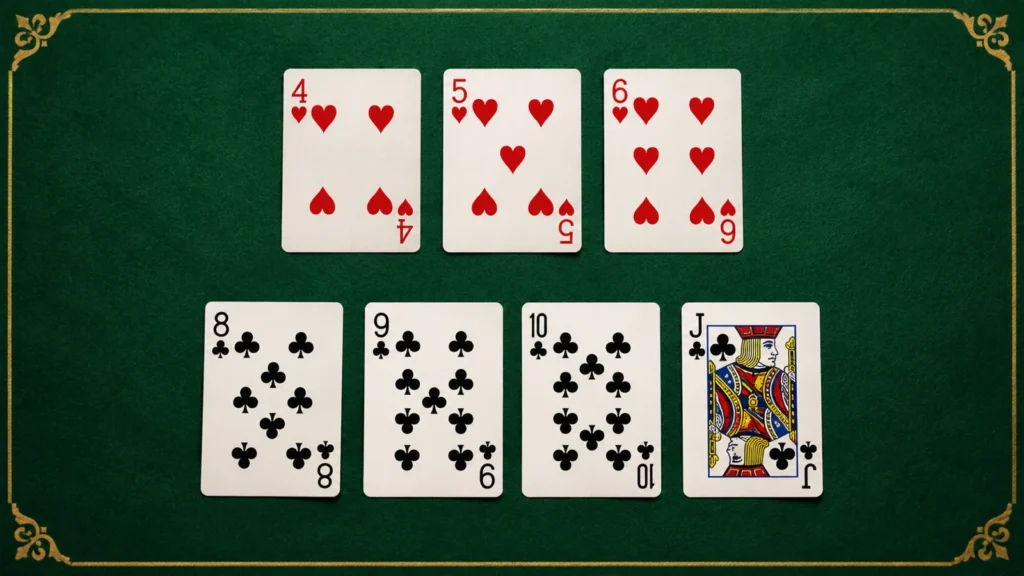
An Indian Rummy sequence needs at least three consecutive cards of the same suit. It can contain four or more cards when every card continues that same-suit rank order.
Three cards is the minimum sequence length
The referenced Indian Rummy rules define a run, or sequence, as three or more consecutive cards of the same suit. That makes 4♥-5♥-6♥ a valid three-card sequence. Two connected cards such as 4♥-5♥ are only a sequence candidate; they are not a complete sequence.
Suit and rank must both work. 4♥-5♣-6♥ has consecutive ranks but mixed suits, while 4♥-6♥-7♥ has one suit but a missing rank. Neither is a valid natural sequence.
Four-card and five-card sequences can be valid
A sequence does not have to stop after its third card. A same-suit 8♣-9♣-10♣-J♣ run contains four consecutive cards and can remain one sequence. The referenced rules also describe valid 13-card hands grouped as 5-4-4 or 5-5-3, provided the hand still contains the required two sequences and at least one pure sequence.
Longer is not automatically better. Keep the longer group only when it supports the full declaration and does not remove a card needed for the second required sequence.
Sequence length and purity are separate checks
A three-card run may be pure or impure, and the same is true of a longer run. Purity depends on whether a Joker substitutes for a missing card, not on the number of cards in the group. Review the pure-sequence guide before relying on a group as the mandatory natural run.
For example, 8♣-9♣-10♣-J♣ is pure when every card is used naturally. If a permitted Joker stands in for 10♣, the group may be an impure sequence under the active rules and cannot replace the required pure sequence.
Do not count one long run as two sequences
A single connected row is one sequence even when it contains enough cards to be split. If a declaration needs two sequences, show two non-overlapping groups and assign each physical card to one group only. Do not count 4♥-5♥-6♥-7♥ as both 4♥-5♥-6♥ and 5♥-6♥-7♥.
When organising an online Indian Rummy game hand, separate the proposed groups visually and use the 13-card sorting method to prevent overlap.
Fit the sequence into the full 13-card declaration
Sequence length is only one part of validation. The referenced structure requires at least two sequences, including at least one pure sequence, and the remaining cards must form permitted sets or sequences. Every one of the 13 cards must belong to exactly one accepted group.
Before the final action, run the valid declaration checklist. Check the active game rules for Joker use, duplicate cards, scoring and any table-specific variation.
Sequence-length check before declaring
- Count at least three cards in every proposed sequence.
- Confirm that the ranks are consecutive and every card has the same suit.
- Treat two connected cards as a candidate, not a complete sequence.
- Keep each physical card in only one non-overlapping group.
- Confirm at least two sequences and at least one pure sequence in the full hand.
- Count all 13 cards once and use the active table rules as the final check.
Frequently asked questions
Can a rummy sequence contain only two cards?
No under the referenced rules. Two consecutive same-suit cards are a useful candidate, but a complete sequence needs at least three cards.
Can a sequence have four or five cards?
Yes, when all cards remain consecutive and in the same suit. The whole 13-card hand must still meet the two-sequence and pure-sequence requirements.
Does a four-card sequence count as two sequences?
No. One connected group counts as one sequence. The declaration needs another separate, non-overlapping sequence.
Does adding a Joker change the minimum length?
The group still needs at least three cards. A Joker may substitute for a missing card under active rules, but that makes the group impure when it is used as a substitute.
Rule source and scope
The minimum run length, same-suit consecutive order, valid longer groupings and two-sequence requirement were checked against Pagat: Indian Rummy: Paplu.