
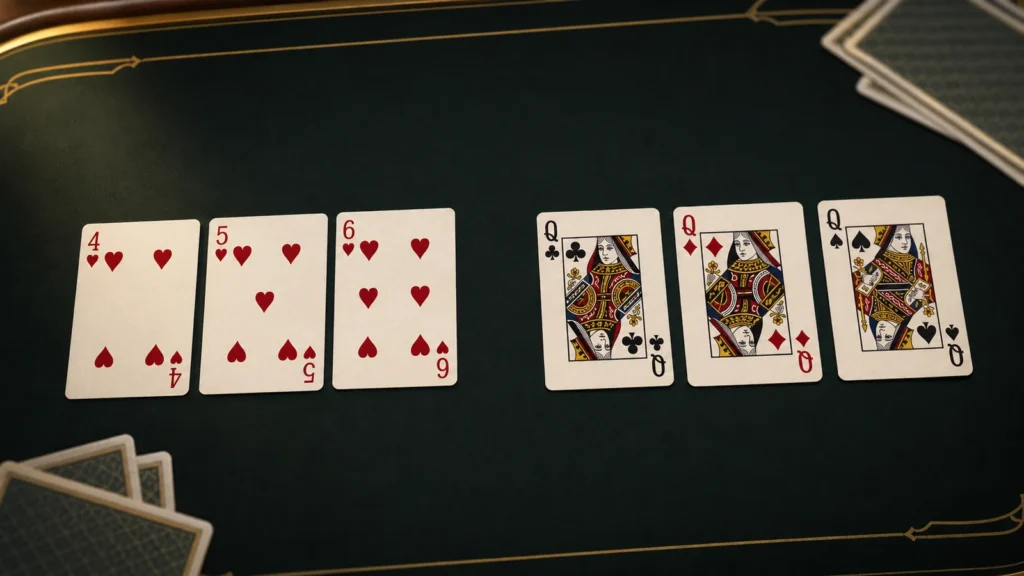
Sets and sequences both organise cards in 13-card Indian Rummy, but they do different jobs. A sequence follows consecutive ranks in one suit; a set groups the same rank across different suits. A valid declaration normally needs at least two sequences, including one pure sequence, so a collection of sets alone is not enough.
What is a sequence in Indian Rummy?
A sequence contains three or more consecutive cards of one suit. For example, 4♥-5♥-6♥ is a natural sequence. A pure sequence uses no Joker as a substitute; an impure sequence may use a permitted Joker to fill a missing rank. Read the pure sequence guide before deciding that a group is complete.
Rank order matters. Ace can commonly be low in A-2-3 or high in Q-K-A, but it does not wrap through K-A-2. Platform rules can vary, so the active table instructions take priority over a general example.
What is a set in Indian Rummy?
A set usually contains three or four cards of the same rank in different suits, such as Q♣-Q♦-Q♠. The cards do not need to be consecutive because rank—not order—connects them. Two queens are only a pair, not a complete set.
With multiple decks, an online Indian Rummy game may expose duplicate physical cards, but duplicate-suit handling can depend on the table. Treat a set as valid only after checking that each card satisfies the active platform rule. A Joker may complete some sets; the Joker rules guide explains why that flexibility still cannot replace the required pure sequence.
Why sequences come before sets in the declaration plan
A set cannot satisfy either of the two required sequence positions. That makes declaration structure more important than the number of groups that look nearly complete. First reserve natural connectors for a pure sequence. Next protect the strongest route to a second sequence. Only then compare the remaining same-rank cards as set candidates.
This order prevents a common mistake: breaking a useful same-suit run to create an attractive set, then discovering that the hand has only one sequence. It does not mean every pair of adjacent cards must be kept. Reassess after each draw and discard using the whole hand, not one isolated group.
A four-step grouping framework
- Mark locked structure: separate any complete natural pure sequence.
- Compare second-sequence paths: prioritise same-suit connectors that need a clear, limited change.
- Build sets from the remainder: group same-rank cards only when doing so does not damage the required sequences.
- Audit loose cards: give each ungrouped card one current purpose or consider it as a discard candidate.
Suppose the hand contains 4♥-5♥-6♥, 9♣-10♣, Q♣-Q♦-Q♠ and four loose cards. Lock the hearts as the pure sequence, keep the clubs as the second-sequence path, and retain the queens as a valid set. The loose cards still need to form valid groups before declaration; the example is a planning snapshot, not a finished hand or a promise of success.
How to decide when one card serves two plans
A card can appear useful in both a sequence candidate and a set candidate, but it can be counted in only one final group. Compare the two plans by declaration need. If the hand still lacks a second sequence, preserving the sequence path has structural priority because another set cannot fill that requirement. If both required sequences are secure, the set may become the cleaner use.
Also compare flexibility: open-ended connectors can accept a card on either side, while an inside gap needs one exact rank. Visible discards can change what seems practical, but opponent behaviour and the closed stock remain uncertain. Use the open-pile versus closed-deck framework when the next draw choice affects both plans.
Common grouping and declaration errors
Frequent errors include calling a two-card pair a set, mixing suits inside a sequence, using non-consecutive ranks, counting the same card twice, treating an impure sequence as pure, or declaring with only one sequence. Another error is assuming a visually tidy layout is automatically valid.
Before selecting Declare, name every group, confirm at least two sequences, verify that one is pure, inspect each set for same rank and permitted suits, and count exactly 13 cards once. Keep the decision educational and bounded; see the responsible gaming guidance for time and spending limits.
Sets and sequences declaration checklist
- Confirm every sequence has at least three consecutive cards of one suit.
- Confirm at least one sequence is pure, with no Joker used as a substitute.
- Confirm the hand contains at least two sequences in total.
- Confirm every set has three or four cards of one rank and follows the table's suit and duplicate rules.
- Assign each physical card to one group only.
- Count all 13 cards once and recheck the active table rules before declaring.
Frequently asked questions
Can a set replace the second sequence?
No under the commonly documented 13-card Indian Rummy structure. The hand needs at least two sequences, including one pure sequence.
Is a pair of the same rank a valid set?
No. A complete set normally needs three or four same-rank cards that satisfy the table's suit and duplicate-card rules.
Can one card belong to a set and a sequence?
It can be considered in competing plans while organising the hand, but the final declaration can count that physical card in only one group.
Should I always keep a three-card set?
Not automatically. First verify that keeping it does not break the pure sequence or the required second-sequence path.
Does a correct grouping framework guarantee a win?
No. It helps check declaration structure, while draws, discards, other players and the final result remain uncertain.
Glossary
- Sequence: Three or more consecutive cards of the same suit.
- Pure sequence: A same-suit run with no Joker substituting for a missing card.
- Set: A group of three or four cards of one rank that satisfies the table's suit and duplicate rules.
- Pair: Two cards of one rank; useful as a candidate but not a complete set.
- Declaration: The submitted grouping of all 13 cards for rule validation.
Rule source and scope
The sequence, set and declaration structure was checked against the independent card-game reference Pagat — Indian Rummy: Paplu.