
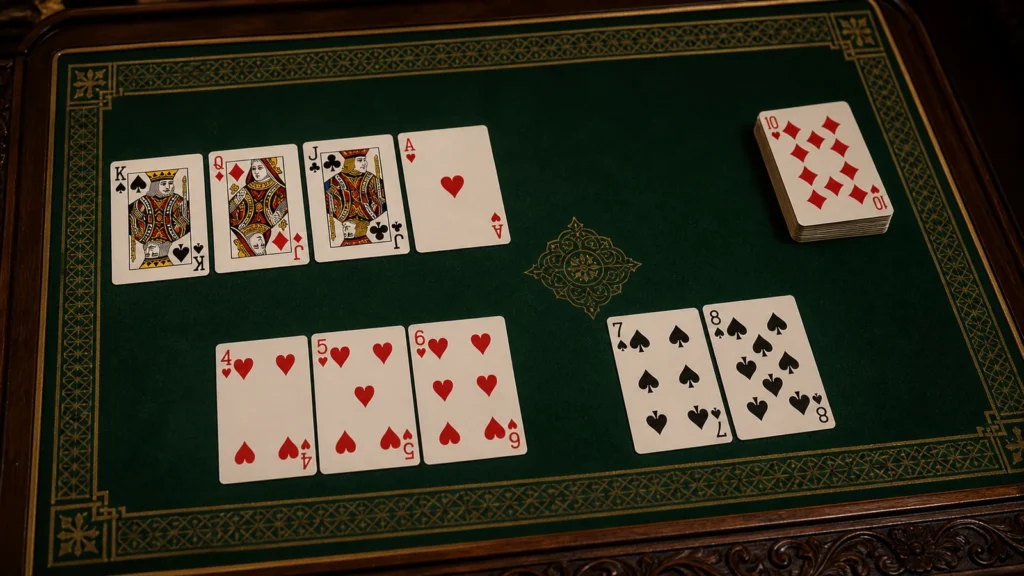
High-point cards are not automatically bad cards. In commonly documented 13-card Indian Rummy scoring, Ace, King, Queen, Jack and 10 each carry 10 points when they remain unmatched. A completed sequence or set can justify keeping one; an isolated card with no clear route can increase exposure. The useful question is not simply whether a card is high, but whether it has a current structural job.
Which cards count as high-point cards in Indian Rummy?
Under the referenced Indian Rummy scoring rules, A, K, Q, J and 10 are each worth 10 points, while numeral cards from 2 through 9 use their face value and Jokers count zero. A 10 is not a face card, but it belongs in the same high-point decision group because its unmatched value is also 10.
Point value is only one input. A Q♥ already inside 10♥-J♥-Q♥ is doing more useful work than an isolated 4♣, even though the queen carries more points. Start with valid structure, not rank alone. The sets and sequences guide explains how to test that structure.
Check sequence structure before reducing points
A valid declaration normally needs at least two sequences, including one pure sequence. Breaking a natural run merely to remove a high card can damage the hand’s required structure. Mark every complete pure sequence first, then identify the strongest realistic route to the second sequence.
Next classify the remaining high cards. A connected pair such as Q♠-K♠ can accept J♠ or A♠ under the common rank order, while an isolated K♦ with no same-suit neighbour or same-rank partner has fewer immediate routes. This is a planning comparison, not a probability claim. Draws remain uncertain, and the active table rules take priority. Review the pure-sequence framework before weakening a natural run.
A four-question keep-or-discard framework
- Is the card already in a valid group? Do not treat a completed sequence or set as loose simply because it contains a 10-point card.
- Does it support a required sequence? Compare same-suit neighbours, open ends and inside gaps, with priority on the pure and second sequences.
- Does it have a credible set route? One same-rank partner is only a pair; weigh that route against stronger sequence candidates.
- What does the visible table show? Discards and open-pile pickups can change a card’s practical value, but they reveal only part of the game.
After these checks, rank loose cards from strongest current job to weakest. If several cards remain isolated, point value can break a tie, but it should not override a clearly better grouping route.
How the decision changes during the hand
Early in a hand, preserve flexible same-suit connections long enough to compare them, but avoid keeping several unrelated high cards only because any one of them might eventually connect. In the middle, reassess after every draw: a new card may complete a route, make another route redundant or turn a former connector into the weakest loose card.
Later decisions deserve a stricter structure audit because another player may declare before a speculative plan improves. There is no universal turn number for discarding every high card. Use the actual groups, the visible pile and the table’s timing. If the draw choice changes the plan, apply the open-pile versus closed-deck framework.
Do not confuse a low-point discard with a safe discard
A lower-point card can still fit an opponent’s sequence or set, and a high-point card may be unusable to them. Because concealed hands and the closed stock are unknown, no ordinary discard can be labelled completely safe. Visible pickups and nearby discards are clues, not proof.
Use a bounded rule: first avoid breaking your required structure, then avoid feeding an obvious recently signalled route when a reasonable alternative exists. Do not invent certainty from one observed card, and do not chase a perfect discard at the cost of your own valid groups.
Worked example: isolated honours versus connected cards
Suppose a hand contains 4♥-5♥-6♥, 7♠-8♠, K♣, Q♦, J♣ and four other cards. The hearts are a completed pure sequence. The spades are a two-sided connector because either 6♠ or 9♠ can extend them. The king, queen and jack are currently isolated unless the remaining cards create same-suit or same-rank support.
Do not discard all three high cards automatically. Check whether one joins a set candidate, whether J♣-K♣ has a realistic Q♣ inside-gap route, and what the visible pile shows. If none has support, compare the weakest isolated card rather than disturbing the hearts or spades. Re-sort after the next draw; the example describes a decision process, not a guaranteed result.
Common high-card discard mistakes
Common mistakes include dumping every Ace or face card immediately, holding all high cards for too long, breaking a completed sequence to lower points, treating a two-card pair as a finished set, and assuming a visible discard proves what another player holds. Another error is forgetting that 10 also carries 10 points under the referenced rules.
Keep the objective educational: improve the clarity of each draw-and-discard decision without promising an outcome. Before play, set time and spending limits and read the responsible gaming guidance.
High-card discard decision checklist
- Mark complete sequences and sets before judging any card by points.
- Protect one pure sequence and a realistic second-sequence route.
- Check same-suit neighbours, open ends and inside gaps for every loose high card.
- Check same-rank support, remembering that a pair is not yet a complete set.
- Use visible discards and pickups as limited clues, never as certainty.
- Discard the weakest current route, then re-sort the whole hand after the next draw.
Frequently asked questions
Should I always discard Ace, King, Queen and Jack first?
No. Keep a high card when it completes or strongly supports required structure; compare isolated cards only after protecting valid groups and sequence routes.
Is 10 also a high-point card in Indian Rummy?
Yes under the referenced scoring rules. A, K, Q, J and 10 each count 10 points when unmatched.
Should I break a high-card pure sequence to reduce points?
Usually that would damage required declaration structure. Judge the complete hand and active table rules before breaking any valid pure sequence.
Can visible discards tell me which high card is safe?
They provide clues, not certainty. Opponents' concealed cards and the closed stock remain unknown, so no ordinary discard is guaranteed safe.
Does this framework guarantee a win?
No. It organises decisions and point exposure, while draws, other players and the final result remain uncertain.
Glossary
- High-point card: A card worth 10 points under the referenced rules: A, K, Q, J or 10.
- Isolated card: A card with no current valid group or clear nearby grouping route.
- Connector: A same-suit card that can link with nearby ranks to build a sequence.
- Inside gap: A sequence candidate missing one specific rank between two same-suit cards.
- Point exposure: The value of unmatched cards that may be counted when another player declares.
Rule source and scope
The card values, 13-card grouping objective and sequence requirements were checked against the independent card-game reference Pagat — Indian Rummy: Paplu.