
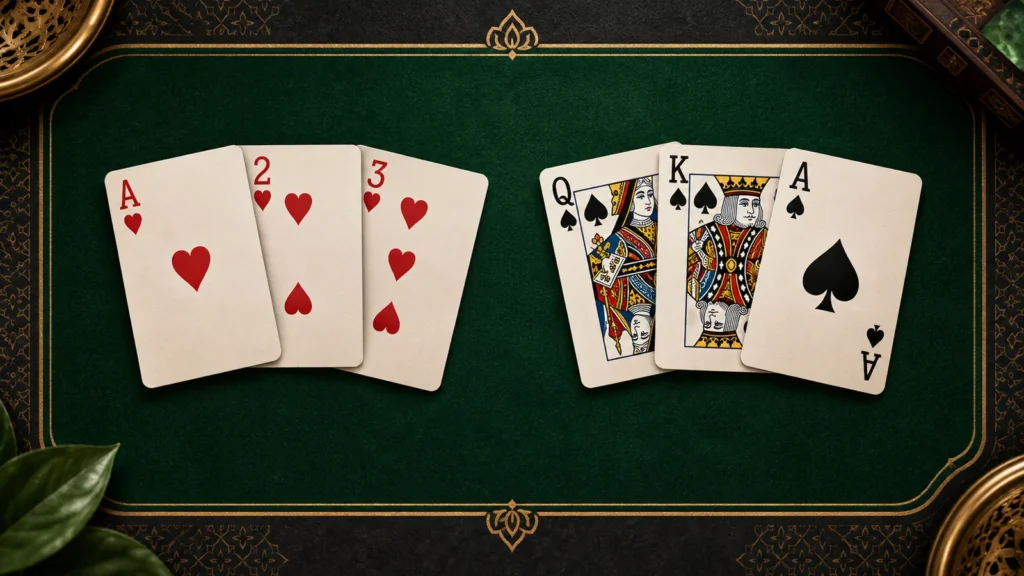
An Ace can sit at either end of the rank order in Indian Rummy. The catch is simple: it cannot connect the King side to the 2 side in one sequence.
The Ace has two legal positions
The referenced Indian Rummy rules place the ranks in the order A-2-3-4-5-6-7-8-9-10-J-Q-K-A. This means an Ace may begin a low sequence such as A-2-3, or finish a high sequence such as Q-K-A.
Every card in the run must still share the same suit. An Ace of hearts, 2 of hearts and 3 of hearts can form a sequence. Mixing suits does not work.
Why K-A-2 is invalid
K-A-2 asks one Ace to be both above the King and below the 2. The referenced rules do not allow that wrap. Treat the low and high ends as two separate routes, not a circle.
This check matters when sorting a new hand. If K-A-2 looks connected at a glance, separate it before planning the rest of the 13 cards.
Choose the Ace route from the cards you hold
An Ace with a 2 has a clear low-side neighbour. An Ace with a King has a high-side neighbour. When both routes appear possible, compare how many natural cards each route still needs and whether either route can become the required pure sequence.
Keep the two candidates in separate zones while using the 13-card sorting method. Do not let one Ace appear in both groups.
Pure and impure Ace sequences
A natural same-suit A-2-3 or Q-K-A can be a pure sequence. If a Joker substitutes for a missing rank, the group may be an impure sequence under the active rules, but it cannot replace the pure-sequence requirement.
Check the Joker rules guide before assigning a wild card, especially when the Ace group is your only planned sequence.
Check the full declaration, not one run
A correct Ace sequence does not make the whole hand valid by itself. The referenced 13-card rules require at least two sequences, including at least one pure sequence, and the remaining cards must form permitted sets or sequences.
Before the final action, use the valid declaration checklist and confirm every group against the table rules.
Ace-sequence check before declaring
- Place the Ace beside the 2 or beside the King, but not both.
- Confirm that every card in the proposed sequence has the same suit.
- Reject K-A-2 and any other sequence that wraps across both ends.
- Use each physical card in only one group.
- Confirm that at least one sequence is pure and that the hand has the required second sequence.
- Use the active table rules as the final declaration check.
Frequently asked questions
Can Ace, 2 and 3 form a pure sequence?
Yes, when the three natural cards have the same suit and no wild card is substituting for a missing rank.
Can Queen, King and Ace form a sequence?
Yes. Q-K-A is a valid high-Ace sequence shape when all three cards share a suit.
Is K-A-2 valid in Indian Rummy?
No under the referenced rules. The Ace cannot be high and low inside the same run.
Does a low Ace count as 1 point?
Sequence position and scoring value are separate. The referenced scoring rules count an unmatched Ace as 10 points, but the active table may use its own scoring terms.
Rule source and scope
The Ace order, valid A-2-3 and Q-K-A shapes, invalid K-A-2 wrap, sequence count and pure-sequence requirement were checked against Pagat: Indian Rummy: Paplu.