
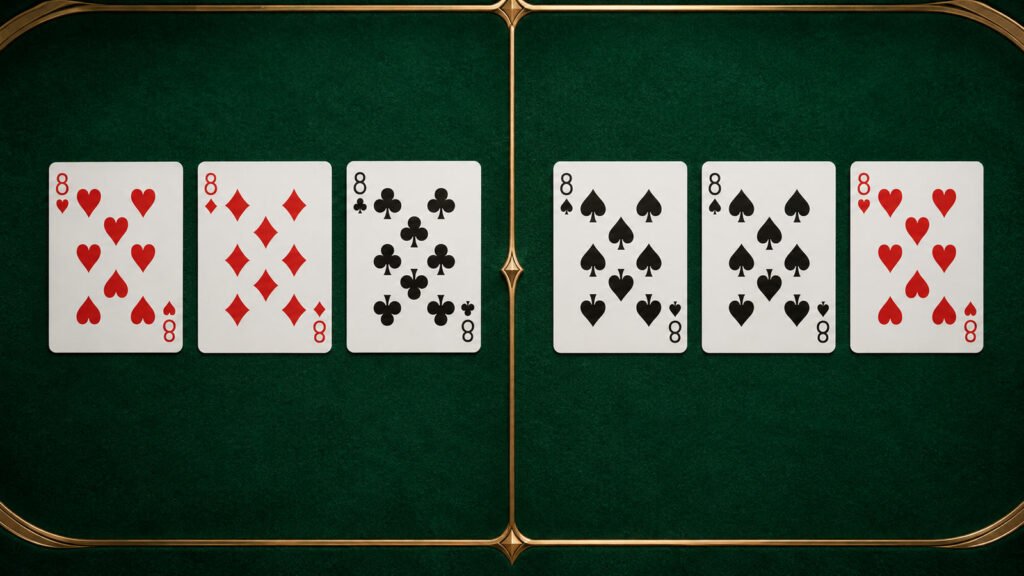
No. In the common 13-card rules referenced here, a natural set uses cards of the same rank in different suits. If a two-deck online Indian Rummy game gives you two identical Eight of Spades cards, both may be real cards, but they cannot sit together as natural members of the same set.
A natural set matches rank, not suit
A set groups cards with one rank and different suits. For example, 8 of hearts, 8 of diamonds and 8 of clubs form a three-card set. A fourth natural 8 may be added only if it supplies the missing suit under the active table rules.
This is different from a sequence, which keeps one suit and moves through consecutive ranks. Review the sets and sequences guide if the two structures are getting mixed together.
Two decks can deal identical cards without making a valid set
When a table uses two decks, two physical copies of the same card can appear in one hand. That explains how two 8 of Spades cards can exist; it does not change the different-suit condition for a natural set.
Keep duplicate same-suit cards in separate sorting lanes. One copy might join a set, while the other may fit a different permitted combination or remain unmatched. Do not count one physical card twice.
A same-suit duplicate is not Tanala in a two-deck game
Two identical cards are not a Tanala. The referenced Tanala variant needs three identical copies and belongs to three-deck play. It is a separate special combination, not permission to repeat a natural suit inside an ordinary set.
Read the Tanala guide only when the active table explicitly recognizes that rule. Otherwise, apply the table’s normal set and sequence definitions.
Jokers do not erase the natural-card suit check
Many online rules allow a printed or wild Joker to stand in for a missing card in a set. That substitution does not make two identical natural cards valid together. Check the natural cards first, then identify exactly which missing rank-and-suit position each Joker represents.
Some platforms allow a Joker-assisted group to contain more than four cards, while other tables present narrower grouping choices. Use the active rule screen as the final authority and consult the Joker rules guide for the basic substitution check.
Audit the complete 13-card hand before declaring
A correct set is only one part of a valid hand. The referenced 13-card rules still require at least two sequences, including a pure sequence, and every physical card must belong to one permitted group.
Before the final action, separate same-suit duplicates, confirm each Joker role, count all 13 cards once and run the valid-declaration checklist. No grouping shortcut can guarantee a result.
Same-suit duplicate check before declaring
- Read the active table's set definition before grouping duplicate cards.
- Confirm that every natural card in the set has the same rank.
- Confirm that no two natural cards in that set repeat the same suit.
- Keep identical copies from a two-deck deal in separate sorting lanes.
- Name the exact card each Joker is replacing instead of treating it as a free extra card.
- Do not treat two identical cards as a Tanala; check the separate three-deck rule.
- Verify the pure sequence, second sequence and all 13 physical cards before declaring.
Frequently asked questions
Is 8♠, 8♠ and 8♥ a valid Indian Rummy set?
No under the referenced normal-set rules. The rank matches, but the two natural 8 of Spades cards repeat the same suit.
Can I keep both identical cards in my hand?
Yes, two decks can produce identical physical cards. The restriction is about placing both natural copies inside one ordinary set, not about holding them in the hand.
Can a Joker make a same-suit duplicate set valid?
A Joker can represent a missing card when the table allows it, but it does not repair two identical natural cards grouped together. Validate the natural cards first.
Can a set contain more than four cards?
Some online rule sets allow extra Jokers to extend a set beyond four cards, while natural cards still need different suits. Check the active table because this grouping detail can vary.
Rule sources and scope
The different-suit requirement, invalid same-suit duplicate examples and Joker-assisted grouping note were checked against RummyCircle: Rummy Rules; Pagat: Indian Rummy: Paplu.